Old kids

illu-crying-babyAls ob ich das wissen wollte: Herr Blumenau mag Herrn Fluch nicht – und vice versa. Das teilen uns die beiden sehr bekannten Musikjournalisten also mit (hier und hier). Nun gut. Nun wissen wir’s.

Angefacht hat die untergriffige Posse Martin Blumenau. Auf seinem FM4-Blog identifiziert er den Standard-Kollegen quasi als das personifizierte Versagen der Print-Pop-(Konzert)-Kritik, ein Versagen, das er in einem „ererbten und unhinterfragten Verzichten auf Kontext, Realität und Verknüpfung“ ortet. Außerdem habe der Herr Kollege „merklich keine Lust, sich mit dem, was er da beschreibt, zu beschäftigen„. Was Wunder, treibe er sich doch „muffig in der letzten Reihe, oder gar in engerem Kontakt mit der Bar“ herum, sodass er nicht „das zentrale Idiom von Pop: den Funken“ mitbekomme.

Der von Blumenau überdies als „Lachnummer“ und „Nestroysche Beamtenfigur“ titulierte Karl Fluch steigt daraufhin in den Ring und sendet einige links-rechts-Kombinationen in des Kollegen Gemächt: Ein „Gutteil aller Texte“ auf Blumenaus-Blog komme daher „wie hoppertatschige Erlebnisaufsätze, insbesondere die so genannten Rezensionen, in denen Sätze wie dieser zu finden sind: „Ein Lied folgte auf das nächste.“ Bei einem Konzert? Echt? Wer hätte das gedacht!

Und so weiter (hier) und so fort (hier) …

Ein Poster (Pseudonym „Sackbauerkarli„) brachte es auf den Punkt:

Kurzfassung
B: ich mag dich nicht
F: ich mag dich auch nicht
B: a bissi mag ich dich schon, aber nur ganz a bissi
F: halts maul!

Kindischer geht’s wohl nimmer!

The American Dream

If there is anyone out there who still doubts that America is a place where all things are possible, who still wonders if the dream of our founders is alive in our time, who still questions the power of our democracy, tonight is your answer.

It’s the answer told by lines that stretched around schools and churches in numbers this nation has never seen, by people who waited three hours and four hours, many for the first time in their lives, because they believed that this time must be different, that their voices could be that difference.

It’s the answer spoken by young and old, rich and poor, Democrat and Republican, black, white, Hispanic, Asian, Native American, gay, straight, disabled and not disabled. Americans who sent a message to the world that we have never been just a collection of individuals or a collection of red states and blue states.
We are, and always will be, the United States of America.

It’s the answer that led those who’ve been told for so long by so many to be cynical and fearful and doubtful about what we can achieve to put their hands on the arc of history and bend it once more toward the hope of a better day.

It’s been a long time coming, but tonight, because of what we did on this date in this election at this defining moment change has come to America.

A little bit earlier this evening, I received an extraordinarily gracious call from Sen. McCain.
Sen. McCain fought long and hard in this campaign. And he’s fought even longer and harder for the country that he loves. He has endured sacrifices for America that most of us cannot begin to imagine. We are better off for the service rendered by this brave and selfless leader.
I congratulate him; I congratulate Gov. Palin for all that they’ve achieved. And I look forward to working with them to renew this nation’s promise in the months ahead.

I want to thank my partner in this journey, a man who campaigned from his heart, and spoke for the men and women he grew up with on the streets of Scranton and rode with on the train home to Delaware, the vice president-elect of the United States, Joe Biden.

And I would not be standing here tonight without the unyielding support of my best friend for the last 16 years the rock of our family, the love of my life, the nation’s next first lady Michelle Obama.

Sasha and Malia I love you both more than you can imagine. And you have earned the new puppy that’s coming with us to the new White House.

And while she’s no longer with us, I know my grandmother’s watching, along with the family that made me who I am. I miss them tonight. I know that my debt to them is beyond measure.
To my sister Maya, my sister Alma, all my other brothers and sisters, thank you so much for all the support that you’ve given me. I am grateful to them.

And to my campaign manager, David Plouffe, the unsung hero of this campaign, who built the best, the best political campaign, I think, in the history of the United States of America.
To my chief strategist David Axelrod who’s been a partner with me every step of the way.
To the best campaign team ever assembled in the history of politics you made this happen, and I am forever grateful for what you’ve sacrificed to get it done.

But above all, I will never forget who this victory truly belongs to. It belongs to you. It belongs to you.

I was never the likeliest candidate for this office. We didn’t start with much money or many endorsements. Our campaign was not hatched in the halls of Washington. It began in the backyards of Des Moines and the living rooms of Concord and the front porches of Charleston. It was built by working men and women who dug into what little savings they had to give $5 and $10 and $20 to the cause.

It grew strength from the young people who rejected the myth of their generation’s apathy who left their homes and their families for jobs that offered little pay and less sleep.

It drew strength from the not-so-young people who braved the bitter cold and scorching heat to knock on doors of perfect strangers, and from the millions of Americans who volunteered and organized and proved that more than two centuries later a government of the people, by the people, and for the people has not perished from the Earth.

This is your victory.

And I know you didn’t do this just to win an election. And I know you didn’t do it for me.
You did it because you understand the enormity of the task that lies ahead. For even as we celebrate tonight, we know the challenges that tomorrow will bring are the greatest of our lifetime — two wars, a planet in peril, the worst financial crisis in a century.

Even as we stand here tonight, we know there are brave Americans waking up in the deserts of Iraq and the mountains of Afghanistan to risk their lives for us.

There are mothers and fathers who will lie awake after the children fall asleep and wonder how they’ll make the mortgage or pay their doctors‘ bills or save enough for their child’s college education.

There’s new energy to harness, new jobs to be created, new schools to build, and threats to meet, alliances to repair.

The road ahead will be long. Our climb will be steep. We may not get there in one year or even in one term. But, America, I have never been more hopeful than I am tonight that we will get there.

I promise you, we as a people will get there.

There will be setbacks and false starts. There are many who won’t agree with every decision or policy I make as president. And we know the government can’t solve every problem.
But I will always be honest with you about the challenges we face. I will listen to you, especially when we disagree. And, above all, I will ask you to join in the work of remaking this nation, the only way it’s been done in America for 221 years – block by block, brick by brick, calloused hand by calloused hand.

What began 21 months ago in the depths of winter cannot end on this autumn night.
This victory alone is not the change we seek. It is only the chance for us to make that change. And that cannot happen if we go back to the way things were.

It can’t happen without you, without a new spirit of service, a new spirit of sacrifice.

So let us summon a new spirit of patriotism, of responsibility, where each of us resolves to pitch in and work harder and look after not only ourselves but each other.

Let us remember that, if this financial crisis taught us anything, it’s that we cannot have a thriving Wall Street while Main Street suffers.

In this country, we rise or fall as one nation, as one people. Let’s resist the temptation to fall back on the same partisanship and pettiness and immaturity that has poisoned our politics for so long.

Let’s remember that it was a man from this state who first carried the banner of the Republican Party to the White House, a party founded on the values of self-reliance and individual liberty and national unity.

Those are values that we all share. And while the Democratic Party has won a great victory tonight, we do so with a measure of humility and determination to heal the divides that have held back our progress.

As Lincoln said to a nation far more divided than ours, we are not enemies but friends. Though passion may have strained, it must not break our bonds of affection.

And to those Americans whose support I have yet to earn, I may not have won your vote tonight, but I hear your voices. I need your help. And I will be your president, too.

And to all those watching tonight from beyond our shores, from parliaments and palaces, to those who are huddled around radios in the forgotten corners of the world, our stories are singular, but our destiny is shared, and a new dawn of American leadership is at hand.

To those – to those who would tear the world down: We will defeat you. To those who seek peace and security: We support you. And to all those who have wondered if America’s beacon still burns as bright: Tonight we proved once more that the true strength of our nation comes not from the might of our arms or the scale of our wealth, but from the enduring power of our ideals: democracy, liberty, opportunity and unyielding hope.

That’s the true genius of America: that America can change. Our union can be perfected. What we’ve already achieved gives us hope for what we can and must achieve tomorrow.

This election had many firsts and many stories that will be told for generations. But one that’s on my mind tonight’s about a woman who cast her ballot in Atlanta. She’s a lot like the millions of others who stood in line to make their voice heard in this election except for one thing: Ann Nixon Cooper is 106 years old.

She was born just a generation past slavery; a time when there were no cars on the road or planes in the sky; when someone like her couldn’t vote for two reasons — because she was a woman and because of the color of her skin.

And tonight, I think about all that she’s seen throughout her century in America — the heartache and the hope; the struggle and the progress; the times we were told that we can’t, and the people who pressed on with that American creed: Yes we can.

At a time when women’s voices were silenced and their hopes dismissed, she lived to see them stand up and speak out and reach for the ballot. Yes we can.

When there was despair in the dust bowl and depression across the land, she saw a nation conquer fear itself with a New Deal, new jobs, a new sense of common purpose. Yes we can.
When the bombs fell on our harbor and tyranny threatened the world, she was there to witness a generation rise to greatness and a democracy was saved. Yes we can.

She was there for the buses in Montgomery, the hoses in Birmingham, a bridge in Selma, and a preacher from Atlanta who told a people that „We Shall Overcome.“ Yes we can.

A man touched down on the moon, a wall came down in Berlin, a world was connected by our own science and imagination.

And this year, in this election, she touched her finger to a screen, and cast her vote, because after 106 years in America, through the best of times and the darkest of hours, she knows how America can change.

Yes we can.

America, we have come so far. We have seen so much. But there is so much more to do. So tonight, let us ask ourselves — if our children should live to see the next century; if my daughters should be so lucky to live as long as Ann Nixon Cooper, what change will they see? What progress will we have made?

This is our chance to answer that call. This is our moment.

This is our time, to put our people back to work and open doors of opportunity for our kids; to restore prosperity and promote the cause of peace; to reclaim the American dream and reaffirm that fundamental truth, that, out of many, we are one; that while we breathe, we hope. And where we are met with cynicism and doubts and those who tell us that we can’t, we will respond with that timeless creed that sums up the spirit of a people: Yes, we can.

Thank you. God bless you. And may God bless the United States of America.

Sam Cooke „A change is gonna come

Strange Fruit

Auf Arte lief eine hervorragende Doku über Black Music, „Schwarz und Stolz – Die Geschichte der schwarzen Musik“ des französischen Regisseurs Marc-Aurele Vecchione. Darin wird die Geschichte der afroamerikanischen Musik von den Worksongs bis zum HipHop mit den gesellschaftlichen Entwicklungen seit dem 17. Jahrhundert in USA kurzgeschlossen. Große Empfehlung für diese Dokumentation, die gespickt ist mit hochinteressanten Zeitdokumenten und raren Konzertmitschnitten.

Billie HolidayStrange Fruit

Southern trees bear strange fruit,
Blood on the leaves and blood at the root,
Black bodies swinging in the southern breeze,
Strange fruit hanging from the poplar trees.

Die Doku wird am 2. November um 09.45 Uhr und am 13. November um 03.00 Uhr wiederholt! Möglicherweise gibt es sie aber auch auf ARTE 7+ zu sehen, wo ausgewählte Sendungen sieben Tage lang im Netz hängen (länger ist leider gesetzlich nicht erlaubt). Also hin und wieder auf http://www.arte.de vorbei schauen. Es lohnt sich in jedem Fall!

Bastards of the Party

California State Prison, Solano

COINTELPRO, the Counter-Intelligence Program, was started by the government. And their whole objective was to neutralize any black movement in America, that they thought a threat. The Panthers being the biggest threat in America at one time (…) They broke down that whole infrastructure very quickly, in two, three years. They turned them against each other, and jailed their leadership. (…) And that’s what made everybody say, wow, see, if you get involved with the politics they’ll kill you. So, I’m just going to look out for me, and my family. It went from community success to individual success. I think that’s where black-on-black crime really just exploded.“ (Interview mit Cle Bone Sloan)

Der Filmemacher Cle Bone Sloan dokumentiert in seinem Film Bastards of the Party, den ich im Rahmen der Viennale gesehen habe, die Geschichte der schwarzen Gangs in Los Angeles. Sloan, mittlerweile inaktives Mitglied der „Bloods„, einer Gang, der er seit seinem 12. Lebensjahr angehört, wofür er mit vielen Jahren hinter Gittern zu bezahlen hatte, erzählt darin auch die Geschichte der Black Community am Beispiel Los Angeles von den 1960-er Jahren bis heute. Ende der 1960-er und Anfang der 1970-er Jahre wird die Black Panther Party von Regierung und FBI zur terroristischen Vereinigung erklärt und zerschlagen, ihre zentralen Figuren getötet oder inhaftiert. Mit der Schließung der Fabriken, in denen hauptsächlich Afroamerikaner beschäftigt waren, kommt in den folgenden Jahren der wirtschaftliche Niedergang der Schwarzen Viertel: Die Väter arbeitslos und die Kids ohne Job-Perspektiven. Der politische Kampf gegen rassistische Diskriminierung geht in den täglichen Fights zwischen den einzelnen Gangs und im gemeinsamen Kampf gegen die Polizei verloren. Die Folgen: Mehr Schwarze – und Latino-Kids in den Gefängnissen als in den Colleges! Das kalifornische Gefängnissystem ist das drittgrößte der Welt (hinter China und den Vereinigten Staaten insgesamt) – seit 1980 sind in Kalifornien 23 neue Gefängnisse errichtet worden -, in dem im Jahre 2007 mehr als 160.000 Menschen inhaftiert waren, zwei Drittel davon waren Afroamerikaner oder Latinos.

California State Prison, Los Angeles

Cle Bone Stone hat den Ausstieg geschafft – seine Mitstreiter, deren Fotos am Ende des Films kurz aufgeblendet werden, nicht. Sie sind tot oder hinter Gefängnismauern weggesperrt – lebenslang.

An Evening of Speed

To me, it all comes from the same source. I could listen to Debussy one minute, then some avant-garde jazz album, then Curtis Mayfield the next. It all comes from the same source.“ (Weller-Website)

Es war irgendwann in den frühen 1990-er Jahren in der Arena, vermutlich im Spätherbst, weil ich mich noch daran erinnern kann, dass ich meine abgetragene, heiß geliebte Raulederjacke trug. Die Halle war berstend voll, und dann ging’s los mit „All the Pictures On the Wall„, einem wunderbar groovigen Song aus dem „Wild Wood„-Album. Ich war sofort in Bann gezogen von der körperlichen Präsenz dieses Sängers, dessen Pulsschlag, so schien es, in Permanenz weit jenseits der 220 schlagen musste, und von der stilistischen Bandbreite der Songs, die Punk- und Psychedelic-Rock, Northern Soul, Funk, Jazz, Klassik, House, Synthi-Pop usw. so unvergleichlich souverän miteinander verknüpften.

Seit diesem Konzert ist Paul Wellers Musik ein zentraler Teil meines Innenlebens, und mir fiele kein anderer Musiker ein, auf den der berühmte Satz von Gustav Mahler, wonach die „Tradition die Weitergabe des Feuers ist und nicht die Anbetung der Asche“ besser gemünzt wäre. Klarerweise habe ich seither auch keinen seiner Wien-Auftritte versäumt – bis auf jenen am 24. November 2002, am Tag der Nationalratswahl, an dem die ÖVP nach fast 30-Jahren wieder zur stimmenstärksten Partei des Landes geworden war. Nach der ersten Hochrechnung, die den klaren Sieg des österreichischen „Thatchers“ (so schlimm sollte es dann doch nicht kommen!) bedeutete und damit Schwarz-Blau auf alle Ewigkeiten einzuzementieren schien, war mir die Lust auf das Weller-Konzert vergangen – ein Entschluss, den ich freilich schon tags darauf bereut hatte, weil ein Weller-Konzert immer etwas ganz besonderes ist.

So auch das jüngste im Konzerthaus, allein schon deshalb, weil das neben dem wunderbaren Jugendstil-Ambiente besondere Asset des Mozartsaals, die einzigartige und in der ganzen Welt gerühmte Akustik, an diesem Abend gegen das Wüten der Punk-Gitarren von Anbeginn an nicht den Funken einer Chance hatte sich zu entfalten. Fuck off! Wozu auch! Ein Super-Gig! Ein Paul Weller-Gig eben!

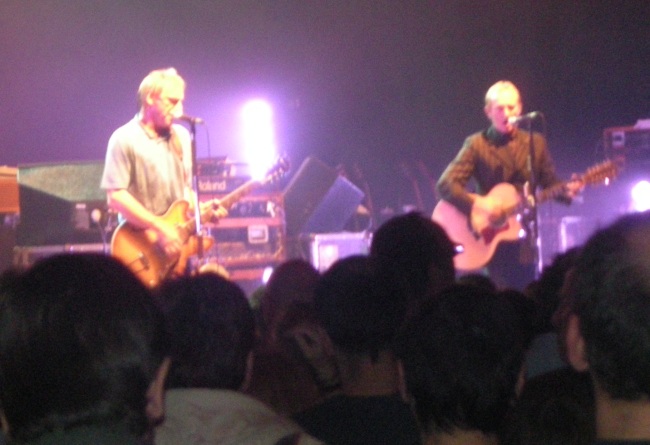
Weller auf der Bühne, das ist der „Dedicated Follower of Fashion“ auf der Bühne, dessen Haare seit Jahren ergraut sind und der mittlerweile auch ein zartes Bäuchlein unter dem Fred Perry Poloshirt trägt, das ist ein Trip mit dem „Magic Bus„, wo bis „Round Midnight“ Songs wie „Happiness is a warm gun“ oder „Move on up“ gespielt werden, aus „Lust for Life“ im Wissen, dass „All day and all of the Night“ nur mit „Whole Lotta Love“ zu überstehen ist. Aber, und das ist das Große an diesem Künstler, seine Songs erweitern all die genannten und befördern sie in Sound-Galaxien, die deren Schöpfern noch unbekannt waren.

Mehrheitlich bestritt der Meister seinen Auftritt mit Songs vom neuen Album „22 Dreams„, hin und wieder einen bekannten Song einstreuend aus seinem überreichen Oeuvre (The Jam, The Style Council und dem Solo-Werk). Nach „Town Called Malice„, dem Jam-Heuler, war Schluss, und der Saal stand längst lichterloh in Flammen.
Danke für den Abend, und bis zum nächsten Mal, Mr. Weller!

Lindschi


Ernst Molden in der Bunkerei

Am 12. September 2003 starb Johnny Cash in Nashville, Tennessee. Auf den Tag genau fünf Jahre später trafen sich einige Seelenverwandte in der Bunkerei im Wiener Augarten, um unter dem Motto „No cash. No hope“ den „Man in Black“ hochleben zu lassen. Mika Vember & Band (große Entdeckung), Ernst Molden und Fritz Ostermayer, der in den kurzen Umbaupausen die randvolle Hütte mit dem Anlass entsprechenden Songs beschallte. Ernst Molden und seine kongenial ins Wienerische transponierten zeitlosen Songs von Dylan, Oldham, Williams, Cave und eben Cash muss man einfach lieben.

Ein Beispiel:
Der Song „Give my love to Rose“ von Johnny Cash, der folgenden Refrain hat:

Give my love to Rose, please, won’t you mister?
Take her all my money, tell her „Buy some pretty clothes.“
Tell my boy that daddy’s so proud of him.
And don’t forget to give my love to Rose.

Bei Ernst Molden heißt der Song „Lindschi„, und hier seine wunderbare Übersetzung des Refrains:

Geh hearst, gib da Lindschi no a Bussi,
bring ihr de zwa Kilo, Oida, sei so guad zu mir,
sag mein Buam, i find eam wirklich leiwand,
und des Bussi legst da Lindschi vur de Tir.

Lindschi“ zum Anhören

Wenn ich solche Texte höre, bin ich nicht nur nahe am Wasser gebaut, sondern längst im Wasser. Danke, lieber Ernst Molden.

Do it yourself


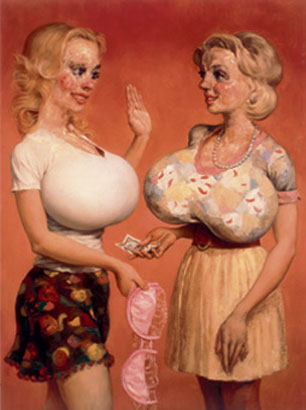
John Currin, „Jaunty und Mame“ (1997)

Da ich mich am Wochenende im Duett mit C. durch die beiden Ausstellung BAD PAINTINGS und Punk – No one is innocent von profunden Kennern führen ließ, genoss ich das Interview mit Paulus Manker im jüngsten Profil ganz besonders. Hier ein kurzer Auszug:

profil: Verfolgen Sie den Wahlkampf?
Manker: Mehr interessiert mich derzeit Amy Winehouse. Da bekommt Kunst endlich wieder diesen verwegen-romantischen Charakter des 19. Jahrhunderts von Baudelaire, Verlaine und später von den Surrealisten. Sie wird wie ein waidwundes Wild gejagt. Und unter dem Brennglas beobachtet man, wie dieser Mensch scheitert und zugrunde geht. Großartig!
profil: Das ist doch tragisch!
Manker: Sie ist eine tolle Künstlerin, hat eine wunderbare Stimme und führt ein völlig verwegenes Leben. Sie macht, was sie will – oder was sie muss, wenn es um Drogen geht. Das geht niemanden etwas an. Dem durchschnittlichen Spießer ist das natürlich too much. Aber wenn die einen Furz lässt, ist das besser als das gesamte Repertoire des Theaters in der Josefstadt! In solchen Sphären hat sich die Kunst zu bewegen! Unerreichbar, unberührbar, jenseitig. Bei uns ist man schon erschüttert, wenn einer einen Joint raucht. Winehouse kann ja nicht wie Maria Rauch-Kallat am heimischen Herd stehen und Fischstäbchen braten!
profil: Diese Leute werden nicht alt.
Manker: Wo steht denn, dass man alt werden muss? Wofür? Für wen? Nur damit man die Pensionen für irgendwelche Halbaffen zahlt? Ich will mein Leben genießen – und wenn es nur 40 Jahre dauert, dann dauert es eben nur 40 Jahre!
profil: Und das Publikum soll dann diese verwegenen Künstlerkerle bewundern, die den Tod nicht fürchten.
Manker: Die Leute bewundern doch den Künstler gar nicht wirklich, sie wollen sich mit ihm nur gemein machen, um ihm dann auf den Kopf zu scheißen. Sie sagen: „Picassos Taube – das kann mein kleiner Fritzi auch.“ Das Lustige ist, der kleine Fritzi könnte es auch, wenn man ihn nur dazu ermutigen würde, dass nämlich nur drei Striche eine Taube sein können oder dass die Omi zwei Nasen und fünf Augen hat. Aber wenn das Kind das dann malt, hört es: „Geh schau, Fritzi, die Omi hat doch nicht zwei Nasen, du bist doch ein Dummerl.“ Dabei ist das die Entdeckung des Kubismus!

Für die Ausstellung Bad Paintings hat Fritz Ostermayer eine Sammlung musikalischer Grausamkeiten zusammengestellt. Unter dem Titel „Bad Taste – Strange Music“ steht sie hier zum gratis Download und anschließendem Leiden bereit. Die 26 Titel umfassende Compilation wird mit den folgenden Geleitworten des großen burgenländischen Vorsitzenden Theodor Kery eingeleitet:

Wir demonstrieren nicht. Wir marschieren nicht. Nein! Wir Burgenländer singen, tanzen und spielen.“

Back to the roots

Am 10. Oktober 2007 hat die britische Band Radiohead ihr Album „In Rainbows“ über die eigene Website im MP3-Format zum Download angeboten – die CD kam erst Ende des Jahres in den Handel. Die Musikfreunde konnten selbst entscheiden, ob sie für das Album zahlen wollten oder nicht, und 62% aller Downloader nahmen das Geschenk dankend an. Einzige Bedingung für den Download war die Bekanntgabe einer Email-Adresse. Trotz dieser „legalen“ Downloadmöglichkeit ist „In Rainbows“ an eben diesem 10. Oktober über 400.000 Mal über die P2P-Software BitTorrent gesaugt worden. Drei Wochen später bereits über 2,3 Millionen Mal.

Dennoch hat sich der ungewöhnliche Schritt für die Band bezahlt gemacht: Radiohead verfügt seither über rund 1,2 Millionen Emailadressen, so oft wurde das Album von der Radiohead-Website heruntergeladen, deren Inhaber mit regelmäßigen Band- und Fan-News gefüttert werden, und dank der weltweiten Aufmerksamkeit für den Werbe-Coup war die folgende Konzerttournee restlos ausverkauft. Auch das kurz vor Weihnachten in den Handel gekommene Radiohead-Box-Set fand beachtlichen Absatz.

Zu diesem Befund kommt eine Studie, die im Auftrag der britischen Verwertungsgesellschaft MCPS-PRS vom Marktforschungsunternehmen Big Champagne durchgeführt wurde, und die als vorweggenommener Nekrolog auf die Musikindustrie gelesen werden kann, weil sie exemplarisch aufzeigt, dass die aus der analogen Welt stammenden Geschäftsmodelle der Musikindustrie im digitalen Kontext verschwinden werden. Daher sind auch alle strategischen Überlegungen der Musikindustrie, deren Fortbestand zu sichern – Wenn wir legale Downloadangebote offerieren und gleichzeitig den Strafverfolgungsdruck auf P2P-User erhöhen, dann können wir sowohl die Nutzung von Tauschbörsen eindämmen als auch die legalen Angebote ankurbeln -, zum Scheitern verurteilt.

Frequently, music industry professionals suggest that an increase in legitimate sales must necessarily coincide with a commensurate reduction in piracy, as if this were a fact. Yet, the company Big Champagne has made no such consistent observation in nearly a decade of analysing these data. Rather, it finds that piracy rates follow awareness and interest. In other words, if you do a good job cultivating a legitimate sales story, you must also expect a similar up-tick in grey market activity. The biggest selling albums and songs are nearly always the most widely-pirated, regardless of all the ‚anti-piracy‘ tactics employed by music companies.

Die Digitalisierung kehrt die bisherige Entwicklung im Musikbusiness gewissermaßen um, indem sie die Branche in die Vor-Tonträger-Ära zurück schleudert, in jene Zeit also, in der Musik von den meisten Menschen via Radio gehört werden konnte und die Radiostationen mit Live-Übertragungen von Big Band-Konzerten, für die sie den Musikern Honorare zu bezahlen hatten, ihre Programme bestritten. Das, was heute als Exklusiv-Event von TV- und Radiostationen vermarktet wird, etwa Live-Übertragungen von Opern- und Konzertübertragungen, war damals die Norm. Während des Zweiten Weltkrieges begannen die US-amerikanischen Radiostationen massenhaft Schallplatten zu spielen, sodass die American Federation of Musicans maschinenstürmerisch für einen Boykott der Schallplattenaufnahmen eintrat, befürchtete sie doch, die Musiker würden ihre Jobs verlieren. Die Gewerkschaft verlangte Ausgleichshonorare von den Plattenfirmen und bedrängte Nachtclubs, keine Jukeboxes mehr aufzustellen. Wenngleich die Radiostationen zwei Jahre lang fast nur Schallplatten spielen konnten, die vor dem Boykott gepresst wurden, und die Gewerkschaft mit den Labels eine Abgeltung aushandeln konnte, die Versuche, den ökonomischen und technologischen Fortschritt aufzuhalten, waren nutzlos – wie immer in der Geschichte.

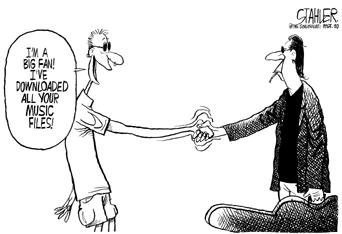
In einer Welt der Tauschbörsen werden Musik-Verkaufsmodelle, egal ob Tonträger oder Download, a la longue obsolet. Wer mit Musik Geld verdienen will, sollte sie einfach verschenken, um Aufmerksamkeit für Live-Konzerte zu generieren.

64 Cent

Wer sich über das Urheberrecht ausführlich informieren möchte, sollte unbedingt das ausgezeichnete Dossier zu diesem Thema auf der Website der Bundeszentrale für politische Bildung (vgl. dazu auch hier) besuchen.

Nun ahnte man ja, dass der Urheber bzw. Künstler am Verkauf seiner CD oder am legalen Download seines Albums nicht gerade berauschend verdienen dürfte; dass es aber lediglich 4% vom Kaufpreis sind, also bei einem CD-Kaufpreis von 15,99 Euro gerundete 64 Cent, hätte man dann doch nicht erwartet. Den höchsten Anteil, rund ein Drittel (knappe 5 Euro), streift das Label ein, das dann „im Interesse und zum Wohle der Künstler“ gegen die P2P-Nutzer vorgeht.

Als ich mir die Liste mit jenen Interpreten angesehen habe, die seit 1990 in Österreich die meisten Tonträger verkauft haben, wurde meine Überraschung noch größer, weil ich eigentlich von wesentlich höheren Verkaufszahlen ausgegangen bin. Spitzenreiter ist demnach Herbert Grönemeyer, der für sein Album „Mensch“ 8-fach Platin erhalten hat, das heißt, von der CD sind 160.000 Stück verkauft worden. An zweiter Stelle rangiert die Erste Allgemeine Verunsicherung (EAV) mit ihrer „Geld oder Leben„-CD, die immerhin noch 5-fach Platin (100.000 verkaufte CDs) bekam. Christina Stürmer liegt mit „Freier Fall“ an dritter Stelle. Die Scheibe erhielt 4-fach Platin, folglich sind über 80.000 Stück verkauft worden. Dann folgen einige Interpreten mit knapp 40.000 verkauften CDs. Die meisten Musiker aber, wie etwa Wolfgang Ambros, müssen froh sein, wenn sie von ihren Alben zwischen 10.000 und 20.000 Stück absetzen. Klarerweise haben Super-Acts wie Herbert Grönemeyer eigene Verträge mit den Labels, die ihnen wesentlich mehr Geld garantieren; aber das Gros der Musikschaffenden kann nicht vom CD-Verkaufserlös leben, sondern muss das Geld durch Live-Konzerte und Tourneen verdienen.

Mit dem Urheberecht bzw. mit der Suche nach anderen Vergütungsmöglichkeiten für Künstler und Interpreten im digitalen Kapitalismus wird sich übrigens auch das diesjährige Ars Electronica Festival (4. bis 9. September) in Linz beschäftigen.